Terms & Conditions
- All items sold by RP Coins are supplied on approval and may be returned for any reason within seven days of receipt. Customers returning goods are responsible for arranging insurance against loss or damage. Third party sales items are sold on approval where indicated. Please see the introduction to that section for further details.
- Clients of known good standing to us will have their goods shipped upon receipt of order or as soon as is practicable afterwards, payment being due upon their receipt of invoice. All other clients’ orders will be held pending payment and shipped on receipt of cleared funds. All goods remain the property of RP Coins until paid for in full.
- Payment should be made in GBP by the following means - cheque drawn on a UK bank made payable to RP Coins. Please do NOT make them payable to R Pearce. Payment may also be made by postal order, banker’s draft or transfer to our bank account at Bank of Scotland, sort code 80-22-60, account no. 29068662. Cheques or money orders drawn on foreign bank accounts in local currency are expensive to process and may take up to a month to clear. If this is the only option available to you, please add £15 to the invoice total to cover the additional charges. Payment can be made using debit or credit cards as indicated.
- Postage will be charged on all orders.
- For UK coin orders up to £50 value the cost is £5.00. Orders over this up to £750 will be despatched by Royal Mail Special Delivery (insured) at a cost of £12 per order. Over £750 is £20 per order. Books and other heavy items will be charged according to the prevailing postage cost for that weight.
- Export sales are supplied net of any UK VAT (where applicable). Import duties or taxes payable in the destination country are the responsibility of the customer.
- All items sold are guaranteed genuine unless indicated otherwise.
Milled
Milled coins are those that have been produced using a mechanical press, or mill. The earliest British coins made by this method were the milled shillings et infra of Elizabeth I produced by the Frenchman Eloye Mestrelle from 1560 onwards. There were further experiments with milled coinage during the reign of Charles I by Nicholas Briot and later by Pierre Blondeau during the Commonwealth period in 1651. The coins depicting Cromwell were also struck by this method, but it wasn't until 1662 that they finally ceased to make hammered coins. All coins made since then have been struck using presses.
| Gold | Silver | Base Metal |
|---|

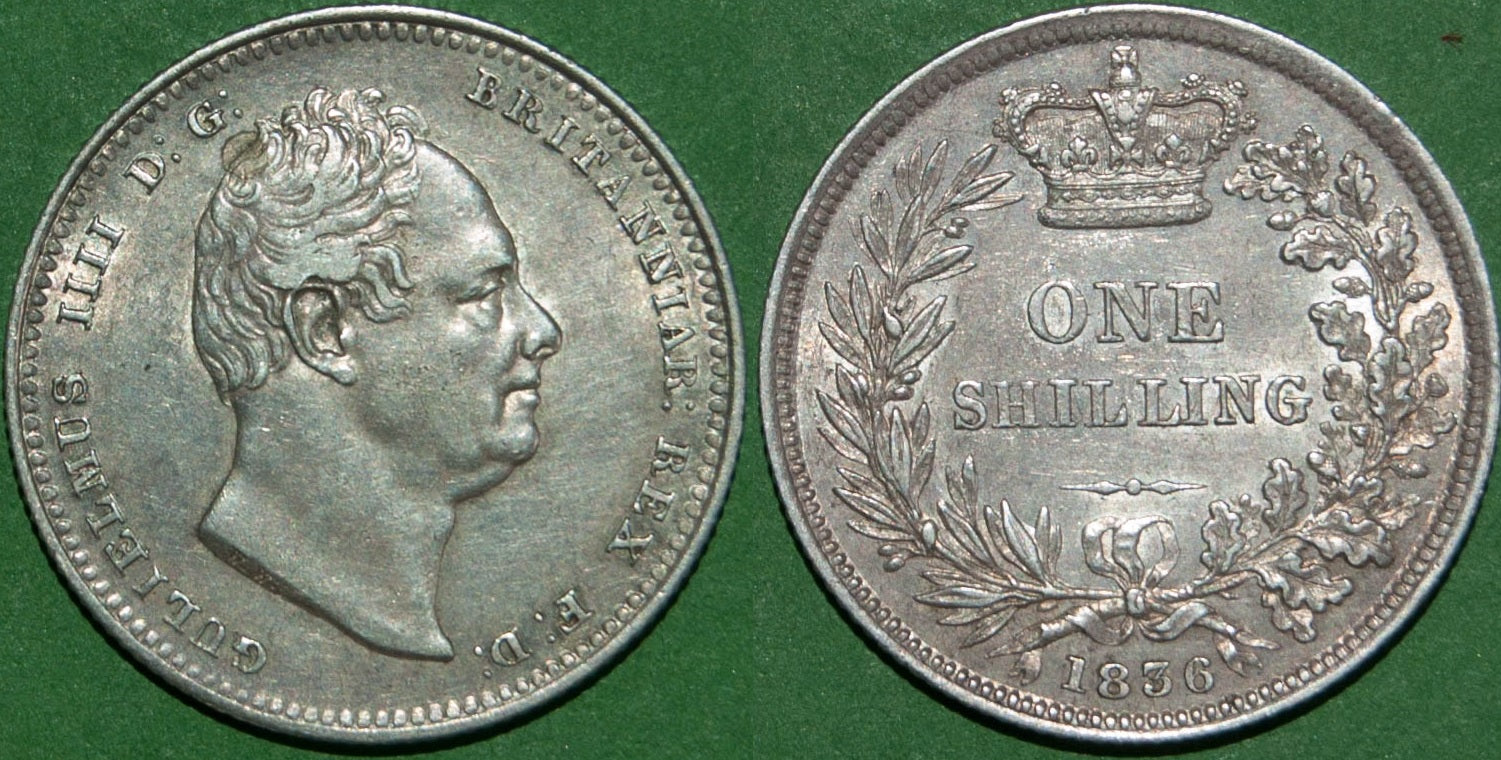
William IV 1836 Shilling
Sold Out
S3835, Davies 345, ESC 2494 (1273). William IV 1836 shilling with flat topped 3 in date. Lightly toned with wear to the higher points, the reverse a touch better. Grade: nEF
© 2026 RP Coins.